


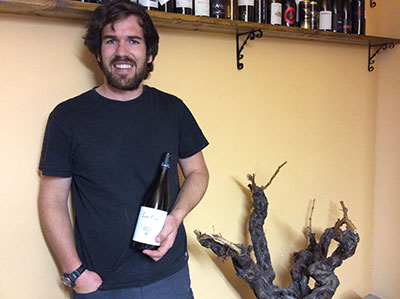
Bryan MacRobert is a South African wine producer who, after falling in love with Ysios winemaker Clara Canals, settled in Rioja to make his own wines. Despite relocating to Europe, he continues to run a small project in his home country, in Swartland.
His time working for Eben Sadie, a leading figure in Swartland and a former co-owner of Priorat’s Terroir al Limit, first brought Bryan to Spain and fostered the habit of harvesting in both hemispheres. His experience in Swartland, but also in Priorat, instilled in him a deep respect for old, dry-farmed vineyards. What struck him most about Rioja was precisely the preservation of old vines, coupled with the ageing potential of its wines.
MacRobert & Canals was founded with the 2013 vintage, initially with grapes bought from different growers. In the early years, the wines were made in rented facilities in Rioja Oriental but now MacRobert has his own winery in Logroño.
Over time, the estate has expanded its holding with a focus on small plots of very old vines scattered across Rioja Alavesa, notably in Villabuena de Álava, Laguardia, Lanciego and Elvillar.
The wines
The project combines influences from Burgundy and the New World, offering two entry-level wines — a white and a red — under the La Nave brand (both priced at €10), alongside a range of single-varietal wines and several single-vineyard bottlings.
Laventura (literally 'The Adventure') is the brand for the varietal wines, retailing at around €20 in Spain. The name echoes the project’s guiding motto, the Spanish proverb “Quien no se aventura no ha ventura” (“nothing ventured, nothing gained”). The grapes are mainly sourced from vineyards in the Sonsierra, reflecting the landscape of slopes that descend towards the River Ebro.
The white wines include a lively Viura with remarkable acidity, fermented and aged for a year in 600-litre barrels, and a more energetic Malvasia made in tiny quantities, fermented on skins and aged on its lees for a year in a concrete egg-shaped vat. The reds include a Tempranillo made from vines grown at 520 metres elevation in Laguardia (over 7,000 bottles), while the Garnacha (over 3,000 bottles) also incorporates grapes from two mountain ranges to the south of the appellation: Moncavillo and the Sierra de la Hez. In this case, the influence of oak is limited by ageing in large foudres.
The single-vineyard range includes three red wines, all aged in 600-litre barrels and made in quantities of fewer than 1,000 bottles, with prices ranging from €30 to €50 in Spain.
Barranco del San Ginés and Paraje de la Virgen are both classified as Viñedo Singular, but this designation is not featured on the label. Barranco del San Ginés, the first wine in the range, comes from a picturesque, 1.3-hectare terraced plot in Laguardia, dotted with two stone shelters and fruit trees amongst the vines. Paraje de la Virgen also displays the freshness expected of vines grown in mountainous areas, expressed here in a more restrained, taut style. It originates from a 0.7-hectare, west-facing plot in Lanciego (Rioja Alavesa) that was planted in 1920 on a gentle slope at 518-550 metres elevation close to the village. Finally, Cuatro Corros comprises the first four small plots that MacRobert purchased in Rioja. These vines were planted between 1930 and 1955 in Villanueva de Álava, also in Rioja Alavesa and include 30% white grapes, lending the wine a transparent, almost crystalline character.
McRobert & Canals is a member of Rioja’n’Roll, a group of terroir-driven producers committed to expressing the personality of their vineyards and terroirs.